Stop Playing Telephone with AI Agents
If you are reading this blog, you shouldn't find it controversial when I say that obviously AI agents should be doing much of the low-level digital work at a company at this point. When you are building software, humans should be reviewing code and giving feedback, not writing it by hand. That ship has sailed.
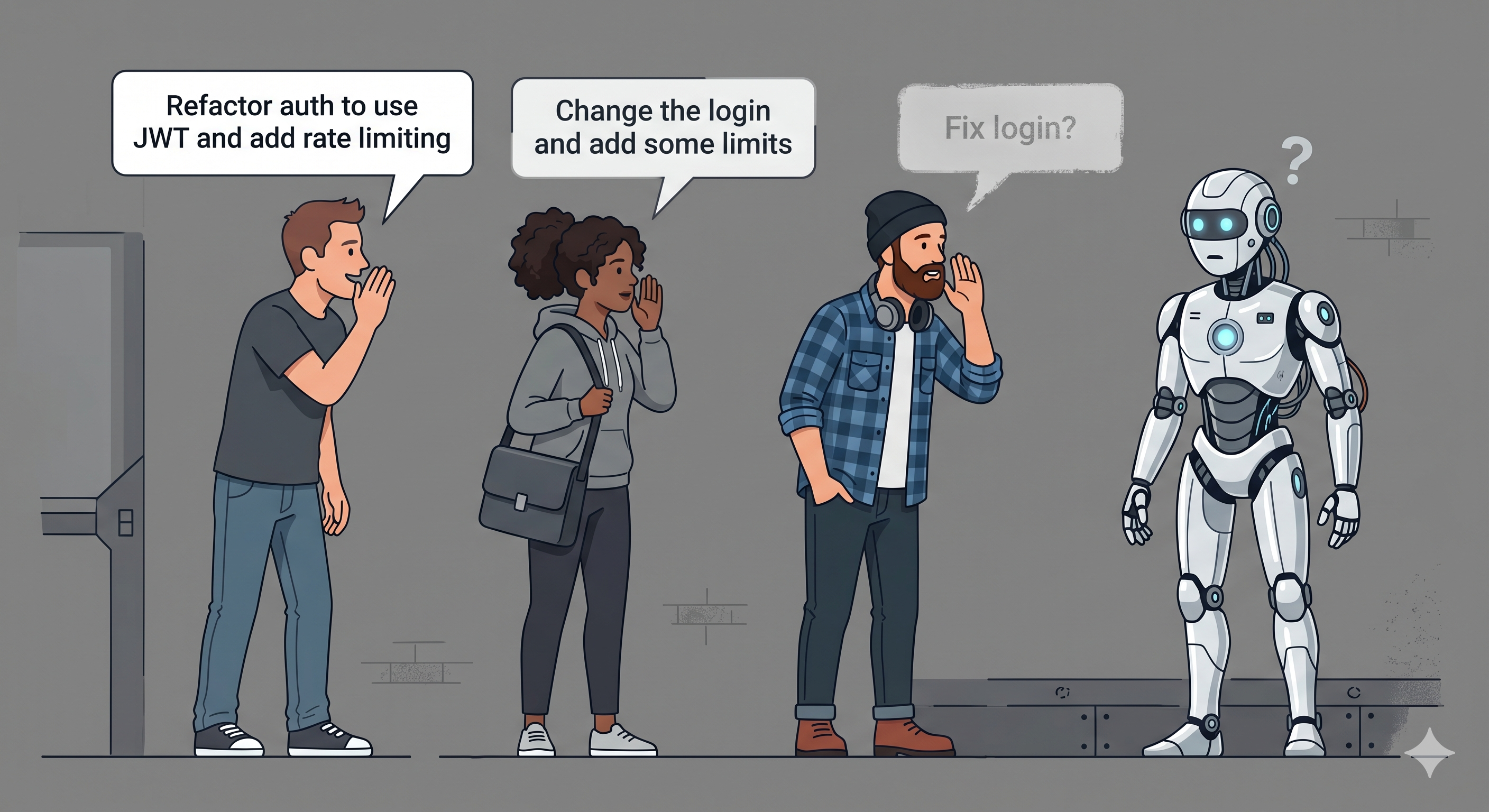
So if an AI agent is doing the actual work, think about what happens in a typical meeting between humans. Let's say it's between you, a manager, and a direct report who is an engineer, talking about what needs to be done on a project. The engineer listens, internalizes it, and then has to turn around and communicate it to an agent. That's Telephone. You might talk for 30 minutes while the engineer builds an understanding of what you want. They have to store all this information in their head, and then they have to reconstruct it all and communicate it to an AI agent. This is a super lossy process. It's a game of Telephone.
And it's not just lossy. It's unfair to the engineer. Their job changed dramatically in the last year. They went from writing code every day where maybe they understood computers really well, and were not the best communicators, to needing excellent communication skills to translate your requests to agents. You're putting them at a disadvantage if you expect them to do this perfectly. No one can do this perfectly.
So we need a new method: we need to get your ideas directly to the AI Agent. Sooo, let's just cut out the humans completely! Just work with the AI directly! Except anyone knows that practically doesn't work: Modern AI is genius-level, but it has weird quirks and limitations like lacking a good visual cortex. So, you want to hand off the task to another engineer and the AI, what do you do?
Just Record the Meeting
You record the meeting, and use a speech-to-text service to get a transcript (implementation details at the end).
Now every word from the discussion is just there, in text. Your 30-minute ramble about what you want, the back and forth, the constraints the engineer brought up, the ideas you fleshed out together? All captured.
By The way, if you are an IC engineer and you're reading: You should request the transcript too! Tell your manager that they'll get better work for everyone on the team if they use yranscripts everywhere and start using them in all the calls that you're in. It will make your life way easier.
Transcripts Are Terrible for Humans, Perfect for Agents
Here's the counterintuitive part: meeting transcripts are terrible for humans. They're rambling, full of false starts, hard to parse. If you talk fast and mumble (like me), the transcript is going to be rough. Your little monkey brain can't read that.
But agents don't care. Give an agent a messy, rambling transcript and it will extract almost everything. The stuff that makes transcripts hard for humans (the length, the tangents, the repetition) is actually helpful for an agent. More context is more signal.Remember, every time you start a conversation with an agent, it's starting fresh. It doesn't know you, it doesn't have years of working relationship with you. It doesn't know your preferences or your communication style or what you actually mean when you say something vague. A long rambling transcript where you go back and forth with someone, repeat yourself, clarify your thinking out loud, contradict yourself and then correct it allow the agent to get to know you.
If you ramble for 5 minutes to a human coworker who already knows you, they'll tune out. If you ramble for 5 minutes to an agent, you just gave it a massive boost in understanding what you actually want.
Rambling is harmful to humans, but beneficial to AI's
Transcripts End the Game of Telephone
Same meeting, same discussion, same ideas. But now every word is captured. The engineer hands the transcript to the agent and says "here's what we discussed, let's build this." The agent can see the full arc of the conversation, including the parts where you changed your mind, including the constraints that came up, including the throwaway comment that actually turns out to be important. Now the engineer can focus on what actually matters: overseeing the agent and augmenting it with their human judgment.
Agent Swarms Have the Same Problem
Quick aside for the people building multi-agent systems: the same logic applies. If you have agents handing off work to other agents without sharing the underlying transcript, you are literally rebuilding the communication problems of large organizations, but with AI. You looked at the game of Telephone and said "yeah let's do that, but with robots." Why would you do that?
The transcript is the source of truth. Share it, always keep it around. Context rot isn't really a problem anymore, and to the extent it still is, it's going away fast. Don't throw away the most valuable thing you have.
For the First Time, This Is Solvable
The game of Telephone has been an unsolvable problem for all of human history. Every large organization suffers from it. Every time information passes through a human or AI brain, it gets distorted.
For the first time, that's preventable. Please don't waste this opportunity to delete the game of Telephone.
At WindBorne, I use Gemini transcripts in Google Meet for every almost every meeting. We also have a bot called SHODAN that you can add to any calendar invite, and it drops the transcript link and action items straight into Zulip. It's not complicated to set up, and it completely changes how work flows from a conversation to an agent.
Record your meetings. Give the transcripts directly to the agents who will be doing work. Stop playing Telephone.